Blog
Discover articles, industry trends, and technical insights to scale your multi-channel e-commerce business.
Featured Post

The Day a Growing Brand Realised It Had Too Many Dashboards
At 9:15 on a Monday morning, everything looked fine.The weekend had been good for a growing fashion brand. Orders had come in from its website, Amazon, and other marketplaces. Sales were moving in the right direction, and the team had plenty to celebrate.Until the questions started.Which products are running low?Did we update the price on every channel?Why does the website show 18 units while the marketplace shows 11?Has that order been shipped?The team had the information.It was just scattered everywhere.One person opened the website dashboard. Another checked a marketplace account. Someone else opened a spreadsheet. A fourth person searched through messages to find an update about an order.The business wasn't short on data. It was short on one clear view of what was happening.When Growth Creates a New ProblemIn the beginning, managing the business was simple. There were fewer products, fewer orders, and perhaps only one or two places where customers could buy. Adding another marketplace felt like a straightforward growth decision.More customers.More visibility.More opportunities.But every new channel also brought another dashboard, another set of product updates, another place to monitor orders, and another inventory number to keep track of.At first, it was manageable. Then the business grew and the process that once took a few minutes started taking hours.The team wasn't spending all its time selling. It was spending time keeping systems in sync.One Product, Multiple PlacesConsider one of the brand's best-selling products: the Urban Black Jacket. The jacket is available across several connected sales channels.A customer places an order. That sounds simple. But behind that single purchase, several things need to happen.The order needs to be captured. Inventory needs to reflect the sale. The fulfilment team needs to know what has to be processed. The product information needs to remain consistent. And the business needs visibility into what is happening across its channels. None of these tasks are particularly complicated by themselves.The challenge comes when every channel manages them differently.One missed update can create another manual check. One inconsistent inventory figure can create confusion.One product change that isn't reflected everywhere can create unnecessary work. The problem isn't necessarily the number of orders.It's the number of disconnected workflows behind those orders.The Dashboard ProblemThe team eventually noticed something strange. They had more tools than ever before, but finding a simple answer was becoming harder.The answer often depended on which dashboard someone checked first. The business had systems for individual tasks, but no simple way to see the larger picture.Sometimes it's the time spent switching between platforms. Sometimes it's the effort spent checking whether information matches.Sometimes it's the uncertainty that comes from not knowing whether an update has reached every channel.The more the brand grew, the more noticeable that friction became.The Question ChangedEventually, the team stopped asking “Which marketplace should we add next and started asking: “How do we manage everything we already have?”That was a different problem. The goal was no longer simply to sell on more channels. The goal was to make those channels easier to manage together. That's where the idea behind O2M comes in!From Multiple Channels to One Connected WorkflowO2M is built around a simple idea:A business shouldn't have to become more operationally complicated just because it sells in more places.Instead of treating every marketplace and sales channel as an isolated workflow, O2M brings connected commerce operations into a more unified environment.Products.Orders.Inventory.Fulfilment workflows.Business data.The idea is to connect these parts so teams can spend less time moving between systems and more time managing the business itself.Back to Monday MorningImagine the same Monday morning again. The team still has orders from different channels. The business is still growing. Inventory is still changing.But instead of starting the day by opening a collection of dashboards, the team starts from a connected view of its commerce operations.They can work with their connected channels, review product information, follow order workflows, and keep track of inventory across the ecosystem.The business hasn't become smaller. The number of orders hasn't disappeared. There aren't suddenly fewer channels. What's changed is the way the work is organized.The questions that once required several checks can now begin from one place.The Real Problem Wasn't Too Many ChannelsSelling across multiple marketplaces isn't the problem. In fact, being present across different channels can be an important part of growing a modern commerce business.The challenge begins when every new channel adds another disconnected process. That's when growth can start creating operational complexity.And that's the problem O2M is designed to address.Building Around the BusinessThe marketplace is where a transaction may happen.But it shouldn't have to become the center of the entire business operation.The business remains the center.Its products, inventory, orders, fulfilment processes, and decisions all belong to the same operation — even when customers discover and purchase those products through different channels.O2M is built with that perspective.Not simply to give businesses another dashboard, but to help connect the workflows that already exist across their commerce ecosystem.Growth Shouldn't Mean More Things to ManageThe fashion brand from our story didn't have a marketplace problem. It had a coordination problem.As the business grew, its sales channels multiplied faster than its ability to manage them as one connected operation. That's a challenge many growing businesses eventually encounter.The answer isn't necessarily to stop expanding. It's to build an operational foundation that can support that expansion.Because selling everywhere should create more opportunities — not more places for your team to lose track of what's happening.One business. Multiple channels. One more connected way to manage them.
Articles (5)
When the Product Is Ready, But the Data Isn’t
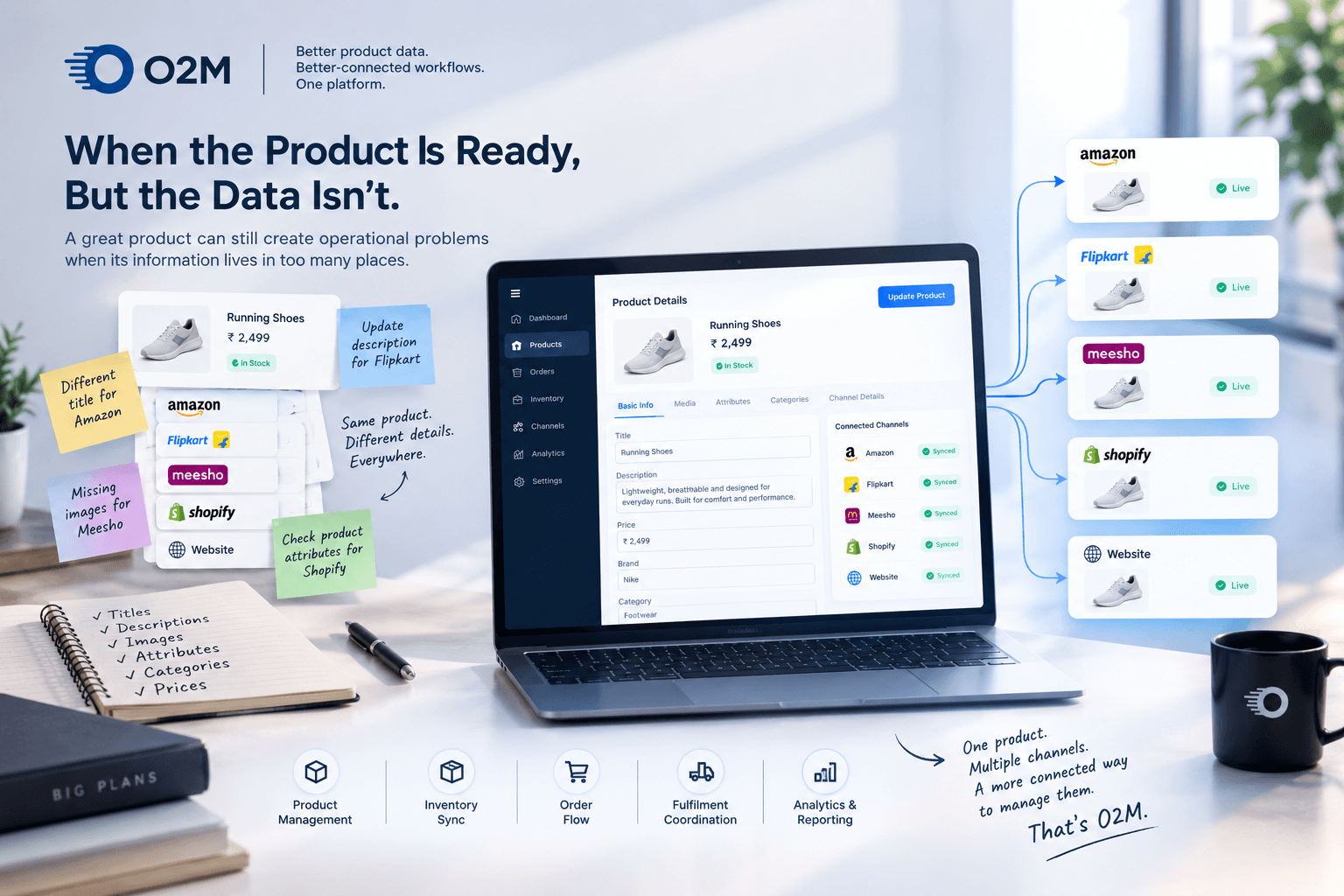
A great product can still create operational problems when its information lives in too many places.A product is ready to launch.The images are approved.The price is decided.The description is written.The inventory is available.It sounds like the hard part is over. But then the team starts preparing the product for different sales channels.One channel needs a different title. Another requires specific attributes.Some product details need to be updated.Someone notices the description is outdated.Someone else finds that an image is missing.The product itself hasn't changed.Its information has.The Product Data Gets ComplicatedFor a growing commerce business, a product isn't just a name and a price.It can include:Product descriptionsImages and mediaPricingInventory informationProduct attributesCategoriesChannel-specific detailsWhen this information is managed separately, small inconsistencies can quickly become another operational task. A team may know exactly what the correct information is.The challenge is making sure that information is organized and available where it needs to be.One Source of Product InformationThis is where a connected commerce workflow becomes important.Instead of treating every sales channel as a separate destination that needs to be managed from scratch, O2M brings product management into a centralized workflow.The team can work with product information from one place and manage its connected sales channels around it.The objective isn't simply to make product entry faster.It's to create a more consistent foundation for everything that happens after the product is created.Because product information doesn't stop mattering after a listing goes live.It continues through orders, inventory, fulfilment, reporting, and everyday business decisions.From Product Data to Business OperationsThink about launching 100 products.If each product requires repeated manual work across multiple channels, the workload grows with every listing.Now imagine changing information across those products later.The challenge isn't creating the products once.It's managing them as the business evolves.A connected approach gives the team a clearer way to work with that change.New products can be organized. Existing information can be maintained. Connected channels can be managed from a central workflow And the business can spend less time wondering where a product's information lives.The Bigger IdeaCommerce doesn't begin when a customer clicks Buy Now.It begins much earlier — with the product information that makes the purchase possible.When that foundation is organized, everything built on top of it becomes easier to manage.That's the thinking behind O2M:Connect the product workflow first. Then connect the commerce ecosystem around it.Better product data.Better-connected workflows.One platform built around the way the business operates.That's O2M.
One Product. Five Channels. One Small Update.
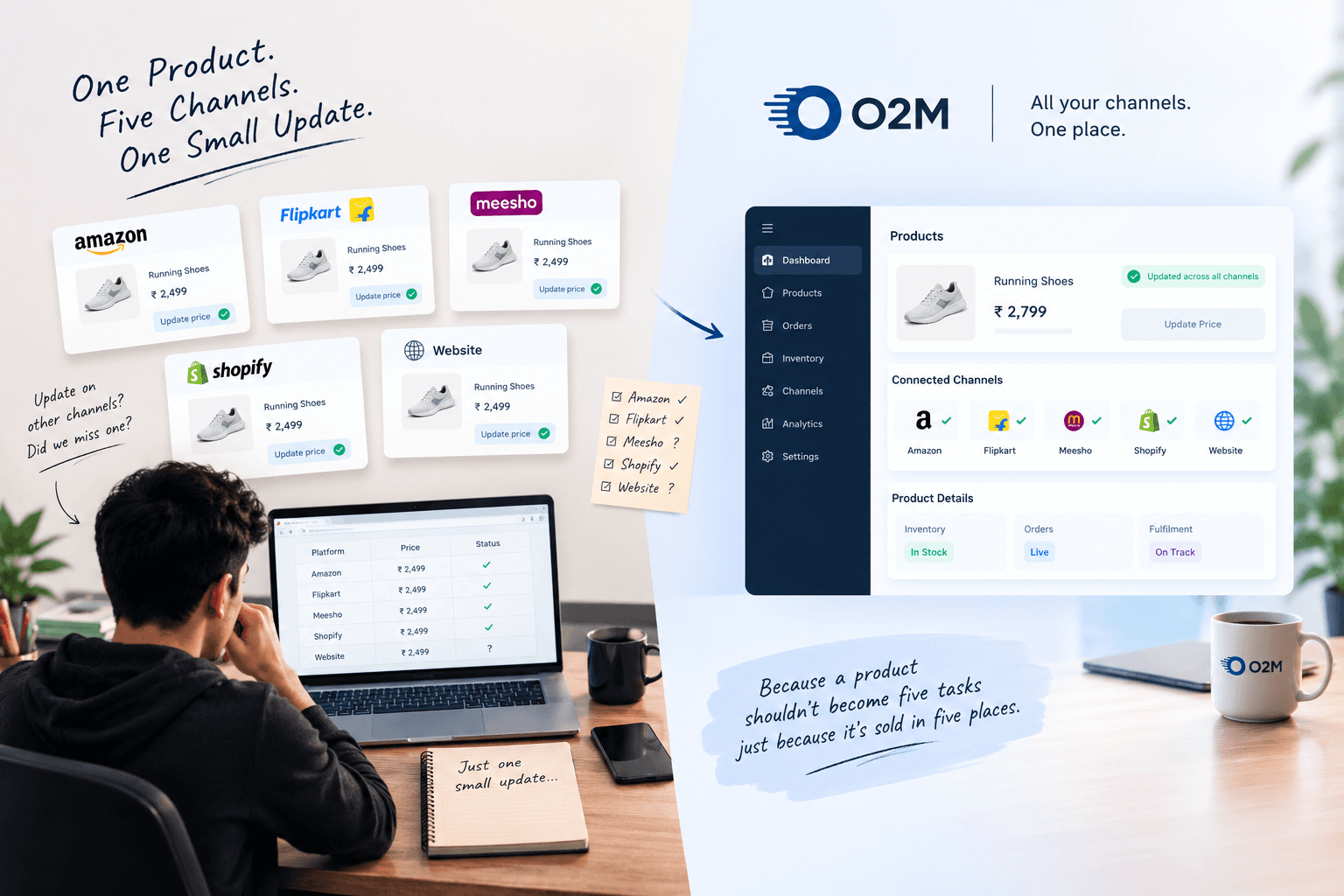
It was a simple change. A brand had decided to increase the price of one of its best-selling products.One number needed to change. Easy, right? Not quite.The product was listed across several sales channels. The team updated the price on one platform.Then another. Then another.Someone checked the website. Someone opened a spreadsheet. Someone asked, “Did we update the other channel?”A five-minute change had turned into a coordination task. And this wasn't unusual.The Real Challenge Isn't Selling EverywhereFor growing brands, being present across multiple channels can create more opportunities.But every additional channel can also mean another place to manage:Product informationPricesInventoryOrdersFulfilment workflowsThe more places a business sells, the harder it can become to keep everything organized.The problem isn't necessarily that businesses have too many channels.It's that those channels can become too disconnected.What If the Business Had One Connected Workflow?That's the thinking behind O2M.Instead of managing commerce operations channel by channel, O2M brings connected sales channels into a more unified environment.So when the business changes, its workflows can be managed with the business in mind— not one marketplace at a time.Because a product shouldn't become five separate tasks just because it's sold in five places.One product.Multiple channels.A more connected way to manage them.That's O2M
How to Sell on Amazon, Flipkart and Other Marketplaces — Without Doing the Same Work Again and Again
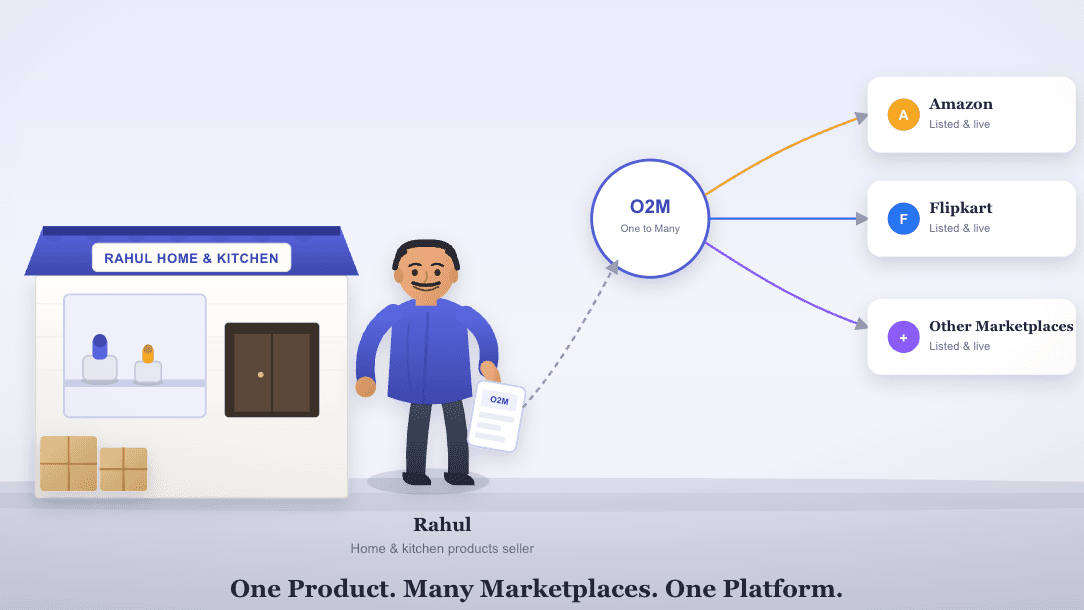
Selling on more than one marketplace is great for business. More marketplaces mean more customers and more sales.But there's a catch — managing the same products on every platform separately can turn into a full-time headache.Let's understand this with a simple example.Meet Rahul: A Seller with a Common ProblemRahul sells home and kitchen products online. His business is doing well, so he decides to expand from Amazon to Flipkart and a few other marketplaces too.Simple idea. Not-so-simple execution.The Problem: Uploading the Same Product Again and AgainLet's say Rahul wants to sell a mixer grinder. He already has everything ready:Product namePriceBrandDescriptionColorPhotosStock countHe uploads all of this on Amazon. Then he opens Flipkart and types almost the same details all over again. Add one more marketplace, and he has to repeat it once more.For 5 or 10 products, this is doable. For 500 or 5,000 products, this becomes hours — sometimes days — of repetitive, boring work.The Solution: Create the Product Once, Sell EverywhereThis is exactly the problem O2M (short for "One to Many") solves.Instead of listing the same product on every marketplace separately, Rahul enters the product details just once in O2M:Product infoPhotosPriceDescriptionStockThen he simply selects where he wants to sell it — Amazon, Flipkart, or any other marketplace. If a particular marketplace asks for a little extra information, Rahul only fills in that missing piece. He doesn't start from scratch.What About Managing Stock?Rahul has 100 mixer grinders in his warehouse. Once he starts selling on multiple platforms, tracking how much stock is left everywhere becomes tricky.Instead of logging into each marketplace to check stock, O2M shows Rahul everything in one screen:Total stock: 100Sold on Amazon: 32Sold on Flipkart: 18Sold on other channels: 10Stock remaining: 40No confusion, no manual counting, no risk of overselling.All Your Orders, One DashboardOnce orders start coming in from different platforms, checking each seller panel separately gets exhausting.O2M brings all your orders into a single dashboard:Amazon — 42 ordersFlipkart — 27 ordersOther channels — 16 ordersTotal — 85 ordersThis gives Rahul a clear, real-time picture of how his business is doing — without switching between five different tabs.Understanding Your Real RevenueAn order doesn't always mean the money is final — it could still get cancelled or returned.O2M breaks revenue down so sellers know exactly where they stand:Pending Revenue – orders still in progressConfirmed Revenue – orders successfully deliveredNet Revenue – the final amount after returns and adjustmentsSo instead of just looking at "sales," Rahul gets a true picture of how much money his business is actually making.In Short: One Product, Many MarketplacesSelling on multiple platforms shouldn't mean doing the same work multiple times.With O2M, the process becomes simple:Create your product once → Sell across marketplaces → Manage stock, orders and returns → Track your real revenue — all from one place.One business. Many marketplaces. One platform.O2M — One to Many. Simplifying marketplace management for growing online sellers.
We thought connecting one marketplace would be easy.
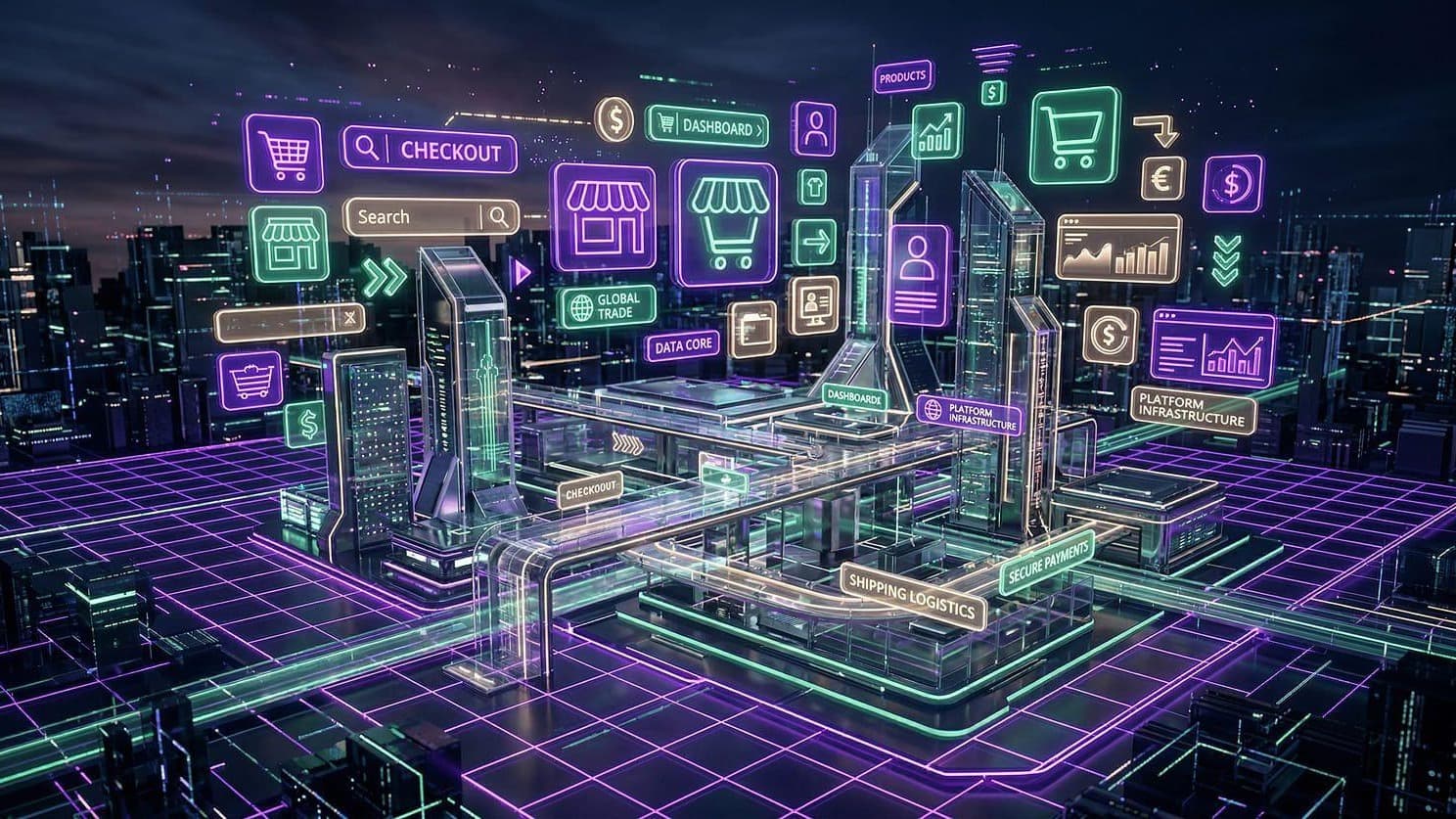
We thought connecting one marketplace would be easy.It wasn't.Then we connected another.That’s when we realized the real problem wasn't the API.It was everything around it.One marketplace wanted the product information one way.Another wanted it differently.Inventory changed in one place.Orders appeared somewhere else.A product that was perfectly valid on one platform could suddenly need completely different information on another.And somewhere in the middle…the seller was expected to keep everything in sync.That didn't feel right.So we started asking a different question:What if marketplaces were connected to the business — instead of the business constantly adapting to marketplaces?That question became O2M.We started building an ecosystem where products, inventory, orders, listings and marketplace operations could work together instead of living in separate systems.But then we discovered another challenge:If we wanted O2M to work with 5 marketplaces, it couldn't be designed for 5.It had to be designed for 50.That changed the way we started building everything.The architecture.The integrations.The data models.The automation.Even the way we think about a single product.We're still building.Still breaking things.Still fixing them.Still asking, “How do we make this simpler?”Because that's the real goal.Not to build another dashboard.To make selling everywhere feel like selling in one place.This is O2M.And we're just getting started. 🚀