
At 9:15 on a Monday morning, everything looked fine.
The weekend had been good for a growing fashion brand. Orders had come in from its website, Amazon, and other marketplaces. Sales were moving in the right direction, and the team had plenty to celebrate.
Until the questions started.
Which products are running low?
Did we update the price on every channel?
Why does the website show 18 units while the marketplace shows 11?
Has that order been shipped?
The team had the information.
It was just scattered everywhere.
One person opened the website dashboard. Another checked a marketplace account. Someone else opened a spreadsheet. A fourth person searched through messages to find an update about an order.
The business wasn't short on data. It was short on one clear view of what was happening.
When Growth Creates a New Problem
In the beginning, managing the business was simple. There were fewer products, fewer orders, and perhaps only one or two places where customers could buy. Adding another marketplace felt like a straightforward growth decision.
More customers.
More visibility.
More opportunities.
But every new channel also brought another dashboard, another set of product updates, another place to monitor orders, and another inventory number to keep track of.
At first, it was manageable. Then the business grew and the process that once took a few minutes started taking hours.
The team wasn't spending all its time selling. It was spending time keeping systems in sync.
One Product, Multiple Places
Consider one of the brand's best-selling products: the Urban Black Jacket. The jacket is available across several connected sales channels.
A customer places an order. That sounds simple. But behind that single purchase, several things need to happen.
The order needs to be captured. Inventory needs to reflect the sale. The fulfilment team needs to know what has to be processed. The product information needs to remain consistent. And the business needs visibility into what is happening across its channels. None of these tasks are particularly complicated by themselves.
The challenge comes when every channel manages them differently.One missed update can create another manual check. One inconsistent inventory figure can create confusion.
One product change that isn't reflected everywhere can create unnecessary work. The problem isn't necessarily the number of orders.
It's the number of disconnected workflows behind those orders.
The Dashboard Problem
The team eventually noticed something strange. They had more tools than ever before, but finding a simple answer was becoming harder.
The answer often depended on which dashboard someone checked first. The business had systems for individual tasks, but no simple way to see the larger picture.
Sometimes it's the time spent switching between platforms. Sometimes it's the effort spent checking whether information matches.
Sometimes it's the uncertainty that comes from not knowing whether an update has reached every channel.
The more the brand grew, the more noticeable that friction became.
The Question Changed
Eventually, the team stopped asking “Which marketplace should we add next and started asking: “How do we manage everything we already have?”
That was a different problem. The goal was no longer simply to sell on more channels. The goal was to make those channels easier to manage together.
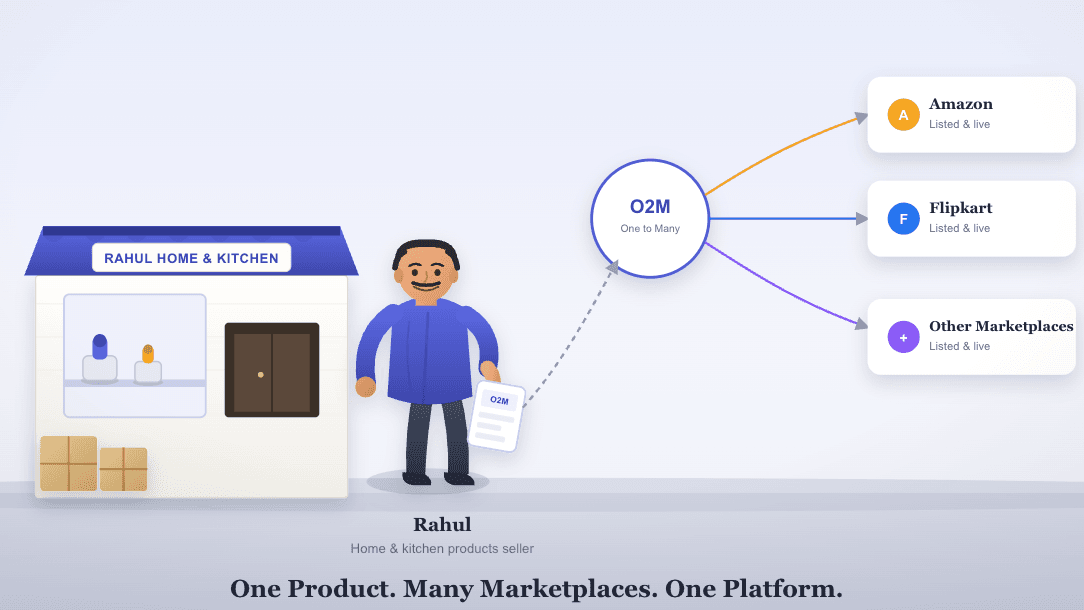
That's where the idea behind O2M comes in!
From Multiple Channels to One Connected Workflow
O2M is built around a simple idea:
A business shouldn't have to become more operationally complicated just because it sells in more places.
Instead of treating every marketplace and sales channel as an isolated workflow, O2M brings connected commerce operations into a more unified environment.
Products.
Orders.
Inventory.
Fulfilment workflows.
Business data.
The idea is to connect these parts so teams can spend less time moving between systems and more time managing the business itself.
Back to Monday Morning
Imagine the same Monday morning again. The team still has orders from different channels. The business is still growing. Inventory is still changing.
But instead of starting the day by opening a collection of dashboards, the team starts from a connected view of its commerce operations.
They can work with their connected channels, review product information, follow order workflows, and keep track of inventory across the ecosystem.
The business hasn't become smaller. The number of orders hasn't disappeared. There aren't suddenly fewer channels.
What's changed is the way the work is organized.
The questions that once required several checks can now begin from one place.
The Real Problem Wasn't Too Many Channels
Selling across multiple marketplaces isn't the problem. In fact, being present across different channels can be an important part of growing a modern commerce business.
The challenge begins when every new channel adds another disconnected process.
That's when growth can start creating operational complexity.
And that's the problem O2M is designed to address.
Building Around the Business
The marketplace is where a transaction may happen.
But it shouldn't have to become the center of the entire business operation.
The business remains the center.
Its products, inventory, orders, fulfilment processes, and decisions all belong to the same operation — even when customers discover and purchase those products through different channels.
O2M is built with that perspective.
Not simply to give businesses another dashboard, but to help connect the workflows that already exist across their commerce ecosystem.
Growth Shouldn't Mean More Things to Manage
The fashion brand from our story didn't have a marketplace problem. It had a coordination problem.
As the business grew, its sales channels multiplied faster than its ability to manage them as one connected operation. That's a challenge many growing businesses eventually encounter.
The answer isn't necessarily to stop expanding. It's to build an operational foundation that can support that expansion.
Because selling everywhere should create more opportunities — not more places for your team to lose track of what's happening.
One business. Multiple channels. One more connected way to manage them.