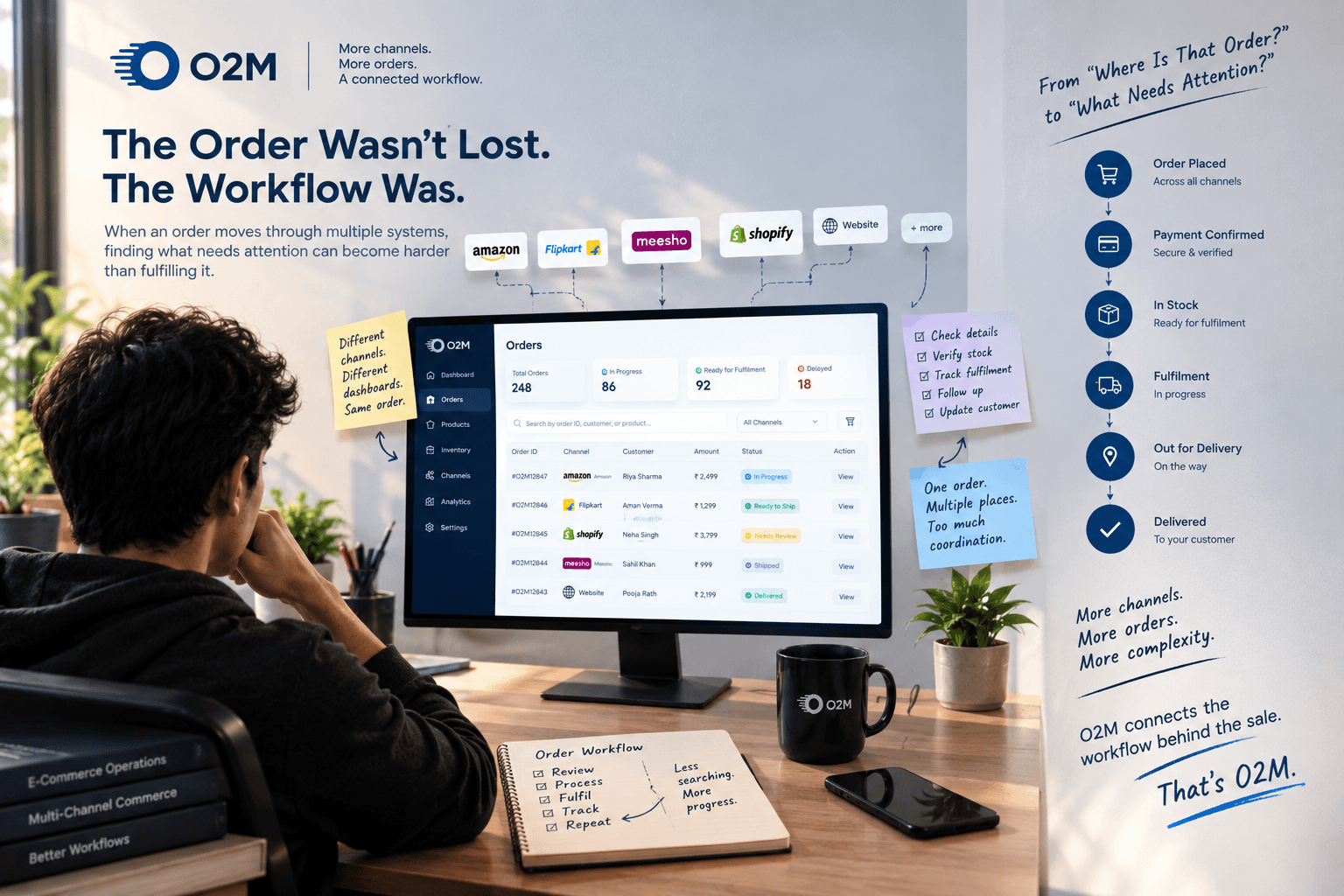
When an order moves through multiple systems, finding what needs attention can become harder than fulfilling it.
At 11:42 AM, a customer placed an order.
The payment went through.
The product was in stock.
The order appeared in the marketplace dashboard.
So why was the fulfilment team still waiting?
The order hadn't disappeared.
It had simply become one more piece of information sitting inside a disconnected workflow.
A Sale Is Only the Beginning
For a customer, an order is simple:
Click → Pay → Receive.
For a business, there is much more happening behind that click.
The order needs to be captured, reviewed, processed, fulfilled, and tracked.
And when orders arrive from different sales channels, teams can end up checking multiple places just to understand what needs attention.
One order might be ready for fulfilment.
Another might need review.
Another might already be moving.
The challenge is knowing which is which without constantly switching between systems.
The More You Sell, The More You Coordinate
Imagine a brand receiving orders from its website, marketplaces, and other connected channels.
The number of orders grows.
So does the operational workload.
Teams may spend time:
Checking different order dashboards
Verifying order details
Following fulfilment status
Coordinating between teams
Looking for updates across systems
None of these tasks are unusual.
But together, they create friction.
And friction becomes more noticeable as the business grows.
What If the Workflow Followed the Order?
That's where O2M takes a different approach.
Instead of thinking about every channel as a separate destination, O2M is designed around connecting the workflows that happen after a sale.
Orders can become part of a more centralized operational view, helping teams understand what has happened, what needs attention, and where each order sits in the process.
The goal isn't simply to collect orders.
It's to make the journey easier to follow.
From “Where Is That Order?” to “What Needs Attention?”
That's a small change in the question.
But it can make a big difference.
When information is connected, teams don't have to spend as much time searching for the information they already have.
They can focus on the work that actually moves the order forward.
Because a growing business doesn't just need more orders.
It needs a workflow that can keep up with them.
More channels. More orders. More complexity.
O2M connects the workflow behind the sale.
That's O2M.